The Best Fluffy Pancakes recipe you will fall in love with. Full of tips and tricks to help you make the best pancakes.


The Art of Making Perfect Chocolate Croissant : A Step-by-Step Guide
There are few pastries as universally beloved as the chocolate croissant, or as the French call it, pain au chocolat. That perfect combination of buttery, flaky layers wrapped around rich dark chocolate is the hallmark of a true French bakery. While making authentic chocolate croissants at home might seem daunting, with patience and the right technique, you can create these luxurious pastries that rival any Parisian boulangerie.
Understanding Laminated Dough: The Heart of French Pastry
The secret to perfect chocolate croissants lies in the technique of lamination. This process involves folding butter into the dough multiple times to create hundreds of thin layers. When baked, the water in the butter creates steam, pushing the layers apart and creating that signature flaky texture that makes French pastries so irresistible.
Essential Ingredients for Authentic Pain au Chocolat
Quality ingredients are non-negotiable when it comes to making exceptional homemade croissants. Here’s what you’ll need for authentic results:
- Bread Flour: The high protein content creates the strong gluten network needed to support all those buttery layers
- European Butter: With its higher fat content (82-85%), it creates superior flakiness and flavor compared to regular butter
- Quality Chocolate: Use proper chocolate batons or a high-quality dark chocolate bar (at least 60% cacao)
- Cold Milk: Helps keep the dough temperature low during mixing
🔘 You Will Also Love White Chocolate Cinnabon Pancakes – A Sweet Breakfast Dream
The Process: Creating Flaky Layers Step by Step
Making the Dough (Détrempe)
Begin by mixing your dough ingredients until smooth and elastic. This initial dough, called the détrempe, should be slightly sticky but manageable. The key here is to develop enough gluten to support the layers while keeping the dough cool. After mixing, chill the dough thoroughly – this first rest period is crucial for relaxing the gluten and making the dough easier to roll out.
🔘 Also Check Our Air Fryer Pancake Cake Recipe | Easy & Fluffy Dessert
Preparing the Butter Block (Beurrage)
While your dough chills, prepare your butter block. European-style butter is essential because its higher fat content and lower water content create better steam and more distinct layers. The butter should be cold but pliable – you want it to be the same consistency as your dough when you begin the lamination process.
More Baking Recipes
Chocolate Chip Walnut Cookies
Cream Cheese Cookies
Lemon Custard Pie
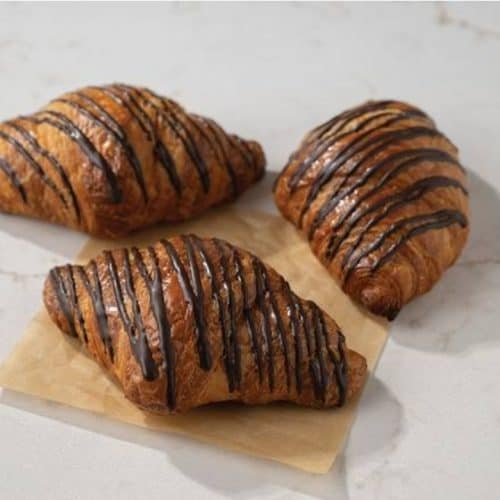
Chocolate Croissant
Creamy Cheesecake Recipe
Banana Pudding Cake
Classic Pain au Chocolat (Chocolate Croissants)
Buttery, flaky, and impossibly light laminated pastry wrapped around two bars of high-quality dark chocolate. This detailed, patient-friendly guide breaks down the art of making authentic French chocolate croissants at home, from creating the detrempe to mastering the lock-in and folds.
Rate This Recipe
Turn On Cooking Mode 💡
Equipment
Ingredients
- 4 cups bread flour high protein is essential for structure
- 1/2 cup granulated sugar
- 2 tsp instant yeast
- 1 tsp salt
- 1 1/4 cups whole milk cold
- 1/4 cup unsalted butter softened, for the detrempe (dough)
- 1 1/2 cups unsalted European-style butter cold, for the beurrage (butter block)
- 8 oz dark chocolate batons or bars high quality, at least 60% cacao, cut into 16 sticks
- 1 large egg beaten with 1 tbsp water, for egg wash
Instructions
- Make the Detrempe (Dough): In the bowl of a stand mixer fitted with a dough hook, combine the bread flour, sugar, yeast, and salt. Mix on low to combine. With the mixer running, gradually pour in the cold milk. Mix for 2-3 minutes until a shaggy dough forms. Add the softened 1/4 cup of butter and mix on medium speed for 6-8 minutes until the dough is smooth, elastic, and pulls away from the sides of the bowl. It will be slightly sticky.
- First Chill: Shape the dough into a flat, 1-inch thick rectangle. Wrap tightly in plastic wrap and refrigerate for at least 1 hour, or up to 12 hours (overnight is ideal).
- Prepare the Beurrage (Butter Block): Place the 1 1/2 cups of cold European butter between two sheets of parchment paper. Pound with a rolling pin to soften it slightly, then roll it into a neat 7×10-inch rectangle. Chill for 20-30 minutes until firm but pliable.
- Lock in the Butter: On a lightly floured surface, roll the chilled dough into a 10×15-inch rectangle. Place the chilled butter block on one half of the dough. Fold the other half of the dough over the butter, like a book. Pinch the edges tightly to seal the butter completely inside the dough package. This is the lock-in.
- First Fold (Turn 1): Turn the dough package so the folded seam is on your right. Roll it out gently into a long rectangle, about 8×24 inches. Using a dry brush, sweep off excess flour. Fold the dough into thirds, like a business letter. This is a single fold. Wrap tightly in plastic and chill for 45-60 minutes.
- Second and Third Folds: Repeat the rolling and folding process two more times, for a total of three single folds. Always start with the folded seam on your right. Chill the dough for 45-60 minutes between each fold. After the third fold, wrap the dough well and chill for at least 4-6 hours, or preferably overnight.
- Shape the Croissants: Roll the chilled dough out on a lightly floured surface into a large rectangle, about 16×12 inches and 1/4-inch thick. Trim the edges neatly. Cut the rectangle in half lengthwise, then cut each half into 4 equal rectangles (you’ll have 8 total). Place two chocolate batons at the short end of a rectangle. Roll the dough tightly over the chocolate. Place the roll seam-side down on a parchment-lined baking sheet. Repeat with remaining dough.
- Final Proof: Brush the shaped croissants lightly with egg wash (avoid the cut edges). Place the baking sheets in a turned-off oven with a pan of hot water on the bottom rack. Let them proof for 1.5 to 2 hours, until they are visibly puffy and jiggle slightly when shaken.
- Bake to Perfection: Preheat oven to 375°F (190°C). Brush the proofed croissants gently with a second coat of egg wash. Bake for 18-22 minutes, rotating the pans halfway, until deeply golden brown and flaky.
- Cool and Serve: Transfer the baked chocolate croissants to a wire rack immediately. Let cool for at least 20 minutes before serving. The chocolate will be very hot. Enjoy warm or at room temperature.
Notes
🔹 Temperature is Everything: The dough and butter must be at a similar, cool temperature. If the butter is too soft, it will melt into the dough. If it’s too cold, it will shatter. The ideal is cold but pliable.
🔹 European Butter is Key: It has a higher fat content (82-85%) than American butter, resulting in flakier layers and better flavor.
🔹 Patience with Proofing: Do not rush the final proof. The croissants should nearly double in size. Under-proofing will result in dense pastries.
🔹 Sharp Tools: Use a sharp knife or pizza wheel to cut the dough to avoid compressing the layers.
🔹 Make-Ahead: After shaping, you can freeze the unbaked croissants on a baking sheet. Once solid, transfer to a bag. Proof from frozen (add 1-2 hours to proofing time) before baking.
Nutrition
Calories: 580kcalCarbohydrates: 58gProtein: 9gFat: 35gSaturated Fat: 22gCholesterol: 85mgSodium: 320mgPotassium: 220mgFiber: 3gSugar: 18gVitamin A: 15IUCalcium: 4mgIron: 25mg
Tried this recipe?
how it was!Baking and Serving Your Masterpiece
Bake your pain au chocolat until they’re a deep golden brown. The smell of butter and chocolate filling your kitchen is the true sign of success. Let them cool slightly on a wire rack – the chocolate will be molten hot initially. While homemade croissants are best eaten the day they’re made, you can refresh them briefly in a warm oven if needed.
Expert Tips for Perfect Croissants Every Time
- Temperature control is everything: Work in a cool kitchen and don’t let the butter get too soft
- Use a ruler: Precise measurements ensure even layers
- Be patient with the proofing: Rushing this step is the most common mistake
- Freeze for later: Shape croissants and freeze before proofing for fresh-baked pastries anytime
Making chocolate croissants from scratch is a labor of love that rewards patience and attention to detail. While the process takes time, the result – biting into a warm, flaky pastry with melted chocolate center that you created yourself – is one of the most satisfying experiences in home baking. Embrace the process, learn from each batch, and soon you’ll be creating French pastries that will transport you straight to a café in Paris.




Croissant Is my Favorite With Coffie.